Nearly every image on this site was made by someone else, long before me. Here they are, by name — and a little of their story.
I draw. Not well yet, but I do, and I am learning, slowly, how to turn a sketch into a piece of art. What I am not is anywhere near the people gathered on this page. I have looked at their work for most of my life and I know the distance.
When this site needed images, I could have generated them. I chose not to. A machine’s picture has no one behind it, and this whole body of work is an argument that someone is always behind it — that a trace is legible because a person left it. So I went looking for real art instead: pieces I already loved, that happened to sit close to what each essay is about, made by hands that were alive. It gave the site a human touch I could not yet supply on my own. Each one is here with where it came from and a few lines of its story, for anyone who wants to read them.
Great things are not done by impulse, but by a series of small things brought together.
Vincent van Gogh, letter to Theo, 22 October 1882
That sentence is the whole argument of this site, written a hundred years before I was born and by someone who was not talking about philosophy at all. It is also why borrowing feels honest to me. Nobody makes anything alone. A theory of coherent existence that pretended otherwise would refute itself on the first page — and the plainest evidence for it is that the people below are still doing work in the world, centuries after they set their brushes down.
If I have seen further it is by standing on the shoulders of giants.
Isaac Newton, letter to Robert Hooke, 5 February 1675/6 — after Bernard of Chartres, c. 1159
Every work here is in the public domain or released under CC0 by the museum that holds it. Where a
collection asks for credit it is given below, and where it does not, it is given anyway. Where an image
appears on this site it has been desaturated and tinted to sit inside the palette; the versions below
are closer to how they actually look, and the collections linked in each line hold the real thing.
Until seventy, nothing I drew was worthy of notice; at seventy-three I began to grasp
how living things grow.
Katsushika Hokusai, colophon to One Hundred Views of Mount Fuji, 1834
The works
Ancient Egypt, 19th Dynasty, The Weighing of the Heart, Book of the Dead of Hunefer (c. 1275 BCE), British Museum.A scene from the Book of the Dead written for the royal scribe Hunefer, showing his heart weighed against the feather of Maat while Anubis steadies the scales and Thoth records the verdict. Painted on papyrus in the 19th Dynasty and now in the British Museum.On Existing
Ancient Egypt, Wedjat (Eye of Horus) amulet (Late Period), The Metropolitan Museum of Art.A wedjat, or Eye of Horus, amulet of the kind buried with the dead and worn by the living for protection and healing. The form recalls the myth in which Horus loses an eye in combat with Seth and has it restored, making the symbol one of wholeness regained.On Watching
Anonymous, for Ferrante Imperato, Cabinet of Curiosities, from Dell'Historia Naturale (1599).A fold-out woodcut from the naturalist Ferrante Imperato’s Dell’Historia Naturale, printed at Naples, showing his collection room hung with a stuffed crocodile and lined with specimens. It is generally regarded as the earliest published illustration of a natural history cabinet.Works and Constellation · page banner
John James Audubon, Blue Jay, from The Birds of America, Plate 102 (1827–38).A hand-coloured aquatint from Audubon’s double elephant folio, etched and printed by Robert Havell Jr. in London. It shows three blue jays raiding a nest and sucking eggs, one with yolk dripping from a broken shell — a pointed comment on the birds’ reputation for mischief.The Jay and the Quark
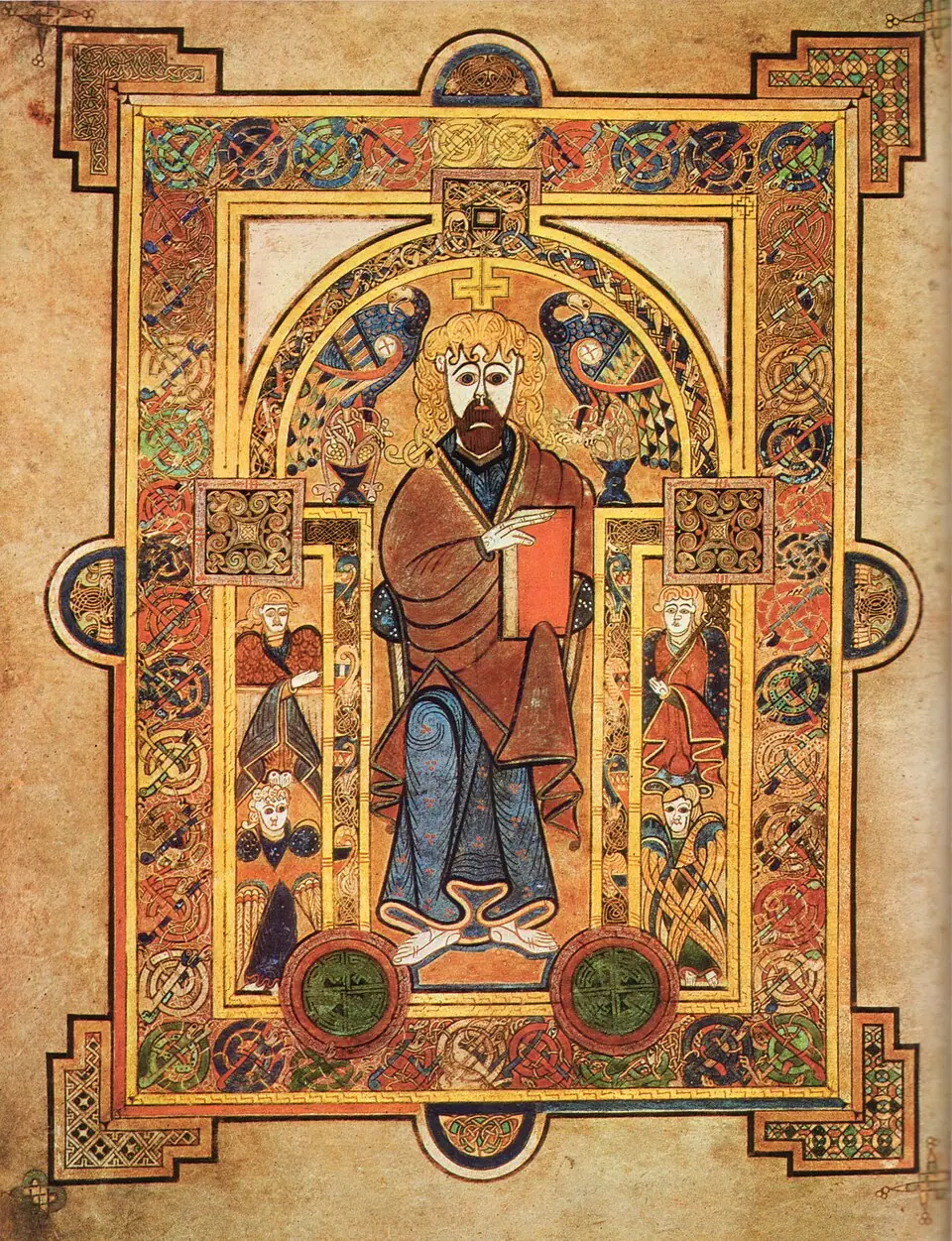
Book of Kells, Christ Enthroned (c. 800), Trinity College Dublin.A full-page miniature from the Book of Kells, an insular Gospel manuscript in Latin created by Columban monks and held at Trinity College Dublin. The page shows Christ enthroned and faces the celebrated Chi-Rho page. The Annals of Ulster call the book “the chief relic of the western world”.Marking the Seam
Byzantine, The Ladder of Divine Ascent (12th century), Saint Catherine’s Monastery, Sinai.An icon of the treatise John Climacus wrote at this monastery around the seventh century, in which the monastic life is a ladder of thirty rungs, one for each year of Christ’s life before his baptism. Monks climb toward Christ, who waits at the top right to receive them; angels attend at the upper left, and demons pull the failing ones off the rungs. It is among the best known works in the monastery’s collection, which survived the Byzantine iconoclasm because Sinai lay outside imperial control.One Step Short · page banner
Mary Cassatt, Maternal Caress (1890–91), National Gallery of Art, Washington.A colour print of a mother pressing her cheek to her child, made using drypoint and aquatint. Cassatt made it after seeing an exhibition of Japanese woodblock prints in Paris, adapting their flat colour and clear outline to a set of ten domestic scenes.On Meeting
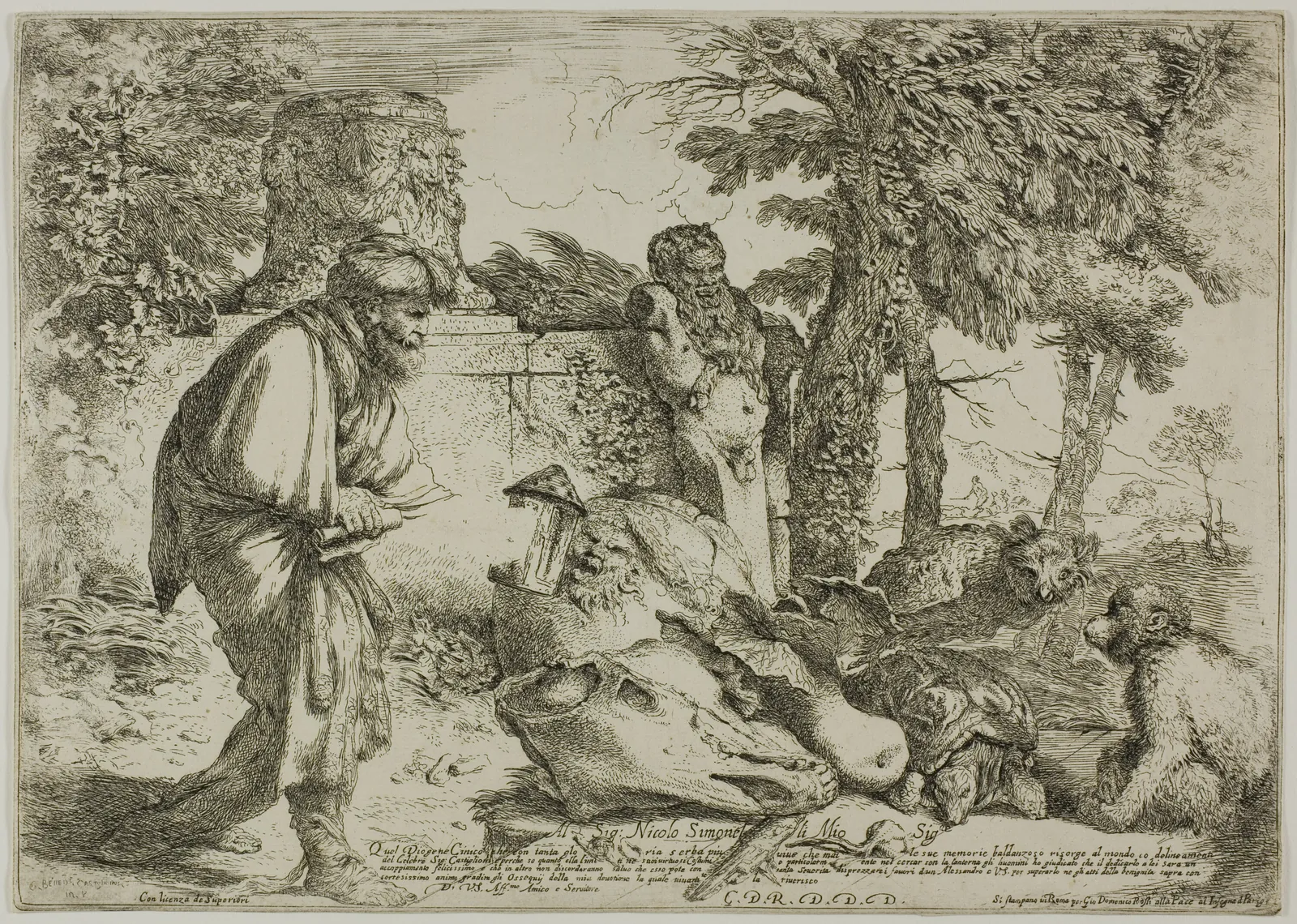
Giovanni Benedetto Castiglione, Diogenes Seeking an Honest Man (1645–47), Art Institute of Chicago.An etching of the Cynic philosopher Diogenes, who was said to walk through Athens in daylight with a lit lantern, looking for an honest man. Castiglione’s Diogenes finds no one at all: only bones, broken statuary and a few watching animals among the ruins. Castiglione, called Il Grechetto, worked in Genoa and Rome and was one of the most inventive etchers of his century.Search · page banner
Andreas Cellarius, Scenographia Systematis Copernicani, from Harmonia Macrocosmica (1660).A hand-coloured plate from the celestial atlas Harmonia Macrocosmica, depicting the Sun-centred universe of Copernicus with cherubs and astronomers crowding the margins. Produced during the golden age of Dutch mapmaking, it is among the most decorative of all star charts.Directions
China, Yuan dynasty, Vajrabhairava Mandala (14th century), The Metropolitan Museum of Art.A Chinese silk tapestry (kesi) of the Yuan dynasty, centred on the buffalo-headed deity Vajrabhairava. Woven into the lower register are portraits of the emperor Tugh Temür, his brother and their empresses, marking it as an imperial commission. Among the largest surviving Yuan tapestries.On Thinking
Codex Sinaiticus (4th century), British Library, London.A fourth-century Greek Bible on parchment, one of the oldest substantial manuscripts of the Christian scriptures and the earliest to contain the complete New Testament. Brought to notice by Konstantin von Tischendorf at St Catherine’s Monastery on Sinai, its removal there remains disputed.On Transmitting
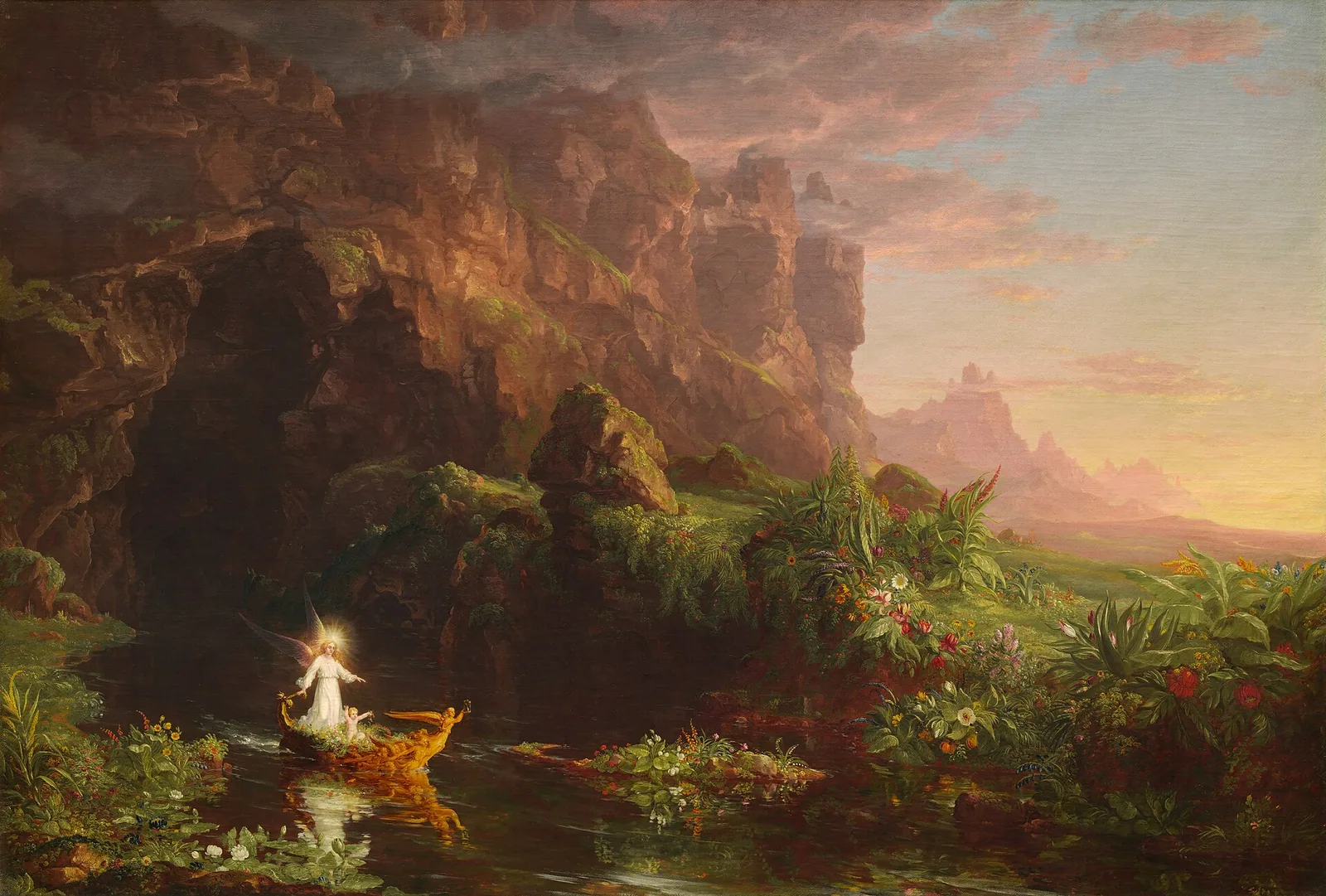
Thomas Cole, The Voyage of Life: Childhood (1842), National Gallery of Art, Washington.The first of four canvases. An infant rides a gilded boat out of a cave mouth into open water, an angel at the tiller and the river ahead still smooth. Cole painted this second set in 1842, after the first, now at the Munson Museum of Art in Utica, left his hands; he wanted a version he could exhibit himself.Home · page banner
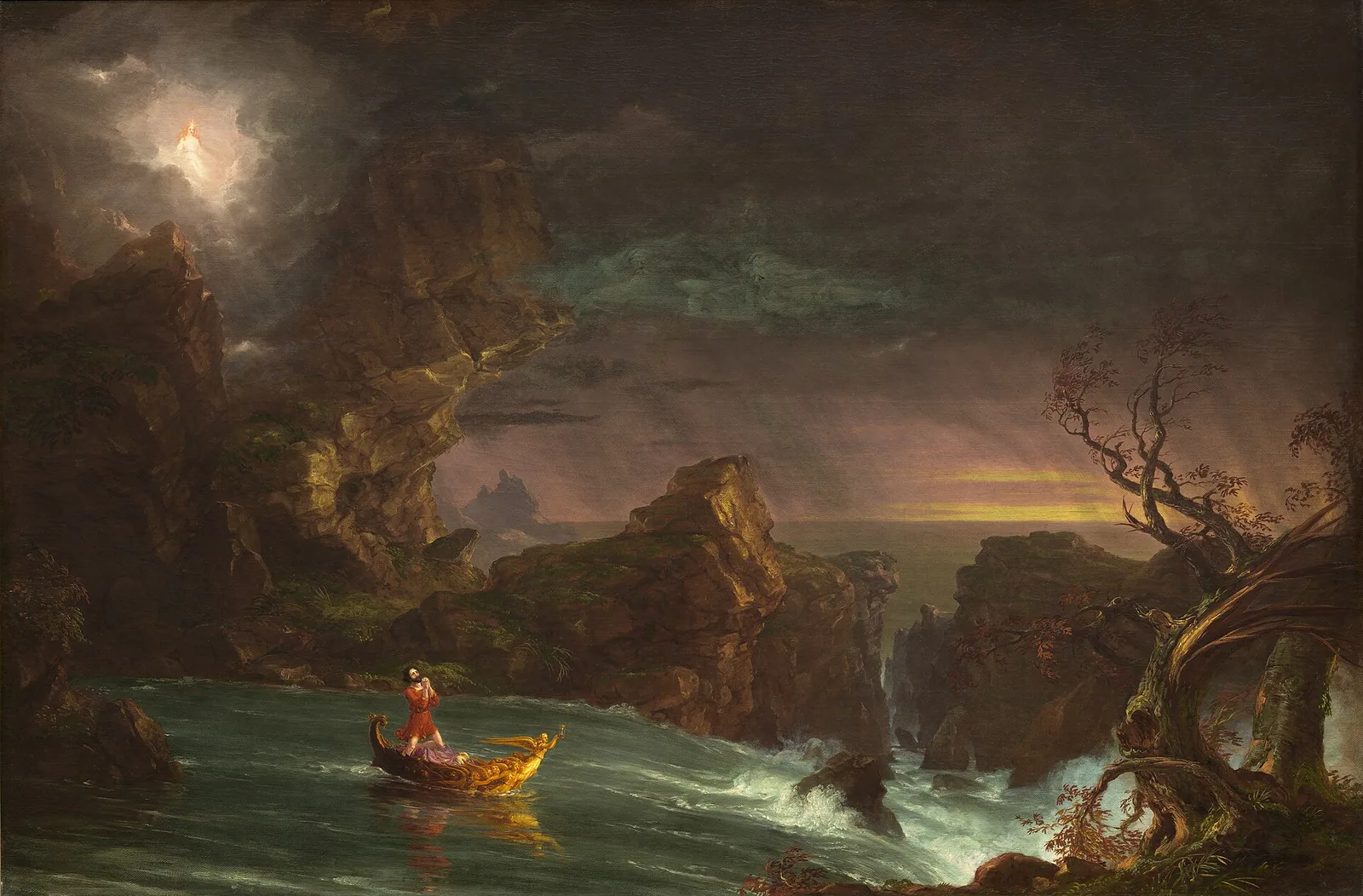
Thomas Cole, The Voyage of Life: Manhood (1842), National Gallery of Art, Washington.The tiller is gone, the water is white, and the boatman rides through a gorge with his hands clasped. Three shapes -- suicide, intemperance, murder, as Cole named them -- ride the storm cloud above; the guardian angel is a small light almost lost in the break of the sky.Home · page banner
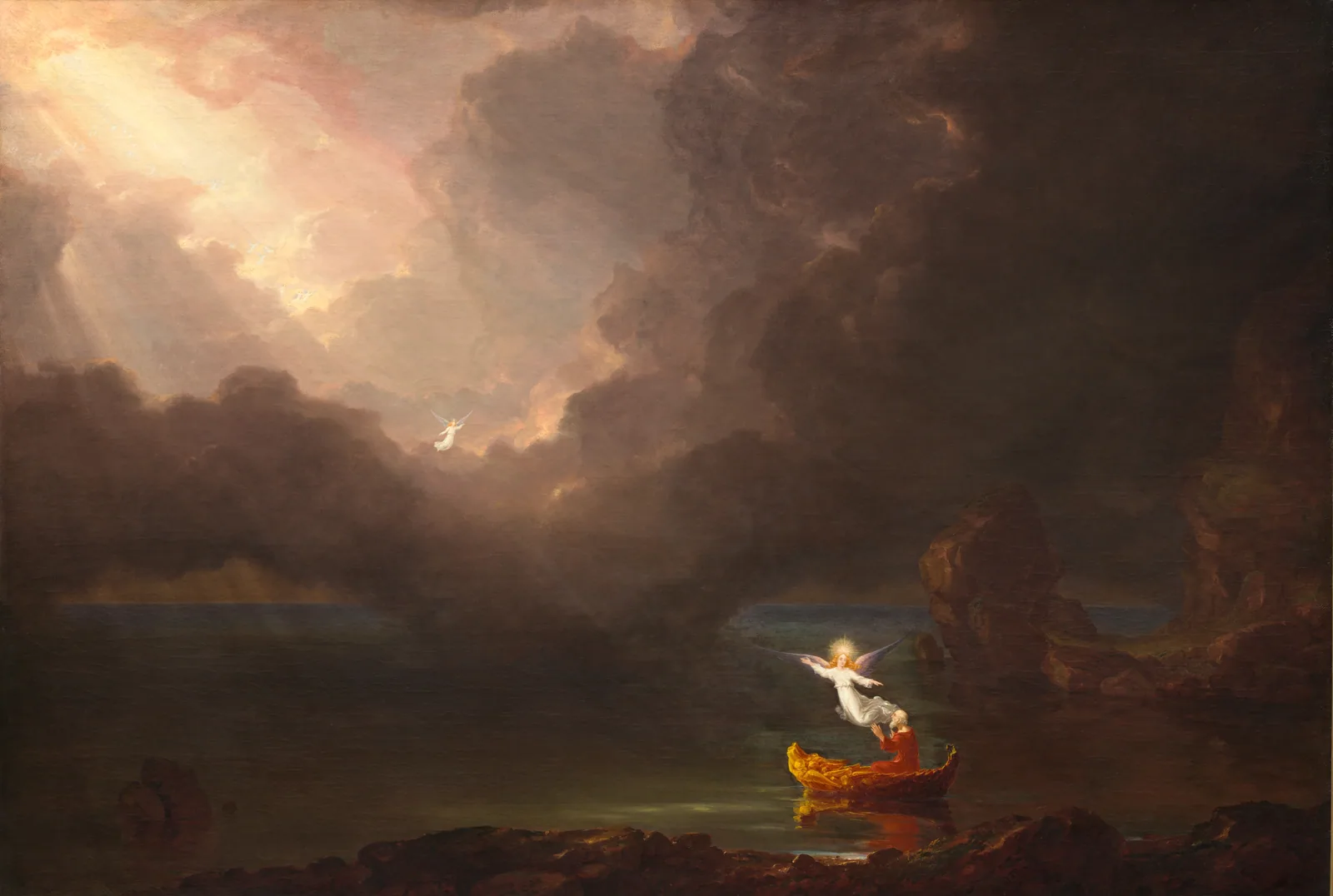
Thomas Cole, The Voyage of Life: Old Age (1842), National Gallery of Art, Washington.The rocks and the river are behind him and the boat sits in still, open water. The prow ornament is broken away, the hourglass on it gone, and the angel has returned to point at a light opening in the clouds. Cole finished the series in 1842 and died six years later, at forty-seven.Home · page banner
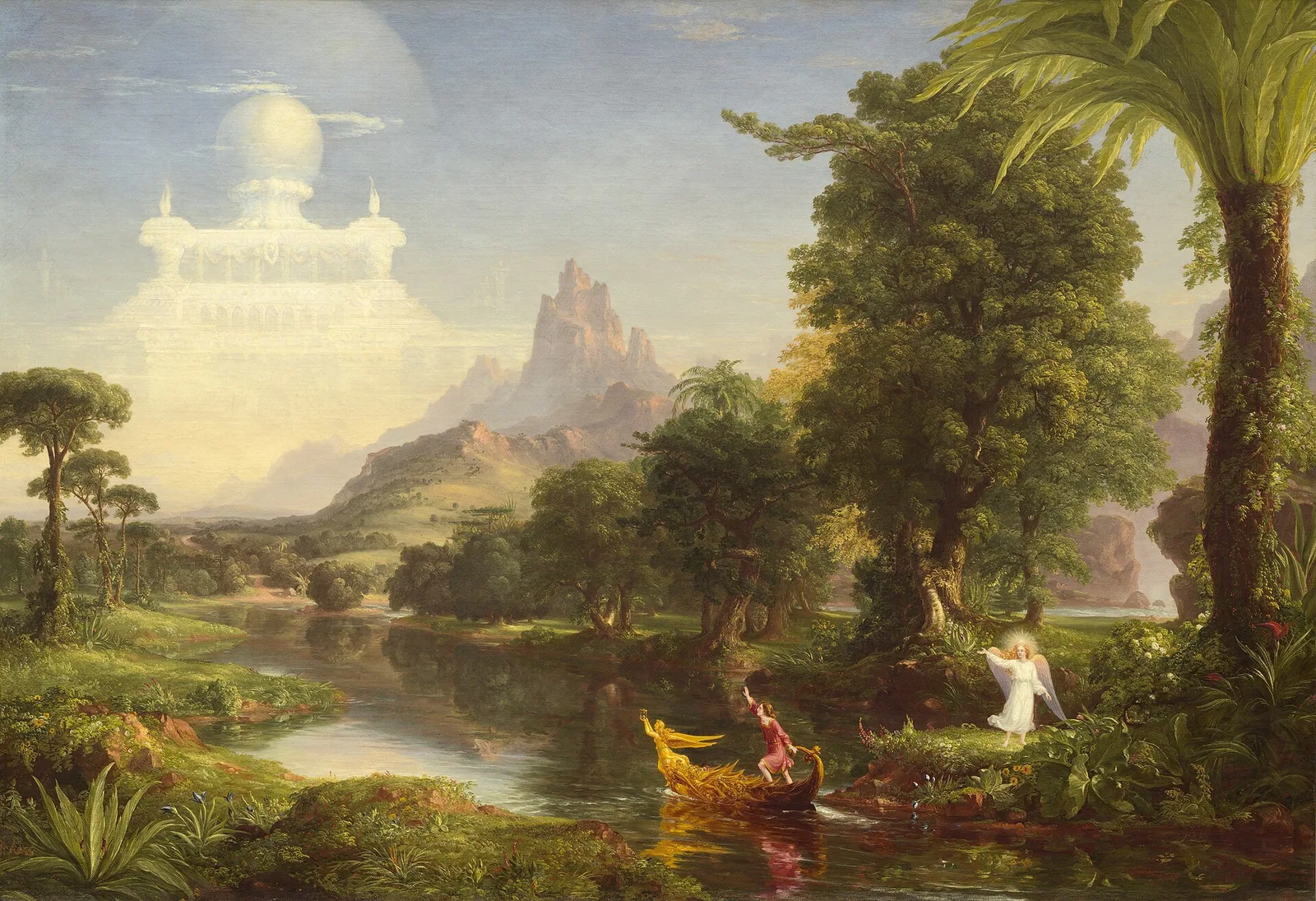
Thomas Cole, The Voyage of Life: Youth (1842), National Gallery of Art, Washington.The traveller has taken the tiller himself and stands to point at a palace of cloud on the horizon. The angel has stepped ashore and watches from the bank. The river bends away to the right, out of sight, toward country the painting does not show.Home · page banner
René Descartes, Rainbow diagram, from Les Météores (1637).A geometrical diagram from Les Météores, an essay appended to Descartes’s Discourse on Method, tracing rays of light through a spherical raindrop. It accompanies his account of how refraction and reflection produce the primary and secondary rainbow at their fixed angles.On Rising
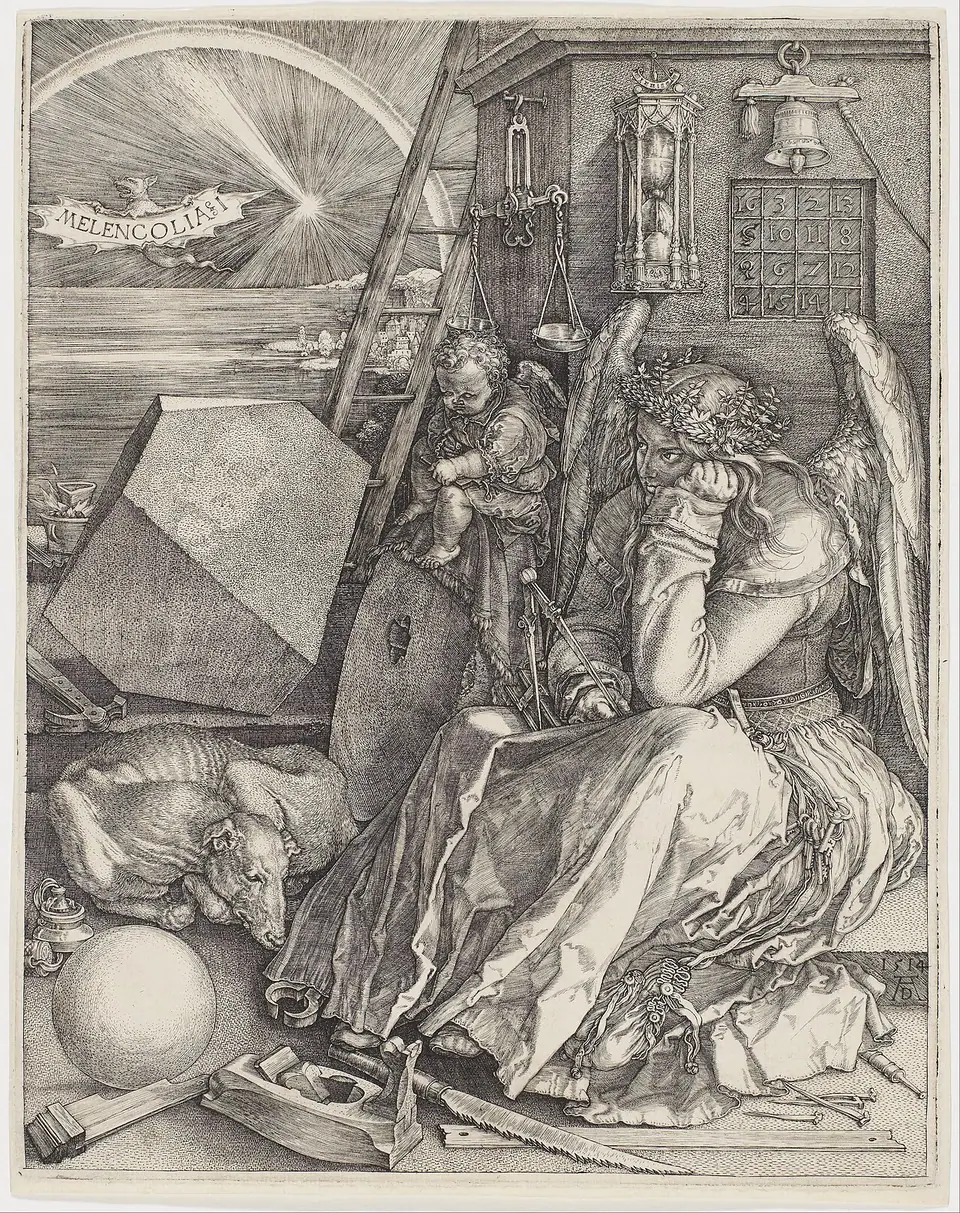
Albrecht Dürer, Melencolia I (1514).An engraving of 1514 in which a winged figure sits brooding amid the tools of geometry and craft, surrounded by a magic square, an hourglass and a polyhedron. The bottom row of the magic square reads 4 15 14 1, encoding the year Dürer made the print.AI and Modern Man
Robert Fludd, Integrae Naturae Speculum Artisque Imago (1617).An engraving showing the cosmos as concentric circles. A chain runs from the hand of God down to a female figure of Nature and on to an ape representing Art, illustrating the old idea of art as the “ape of nature”.The Resonating Hymn of Divinity
Robert Fludd, The Temple of Music (1624), Wellcome Collection.An allegorical engraving in which the elements of music theory are arranged as a temple, complete with Pythagoras, a monochord and the ratios of consonance. A memory-image turning musical knowledge into architecture. Held by the Wellcome Collection.Resonant Recall
Caspar David Friedrich, Moonrise over the Sea (1821), State Hermitage Museum.Figures sit on rocks watching ships return under a moonlit sky. Friedrich, a painter of the German Romantic movement, made contemplative human silhouettes gazing seaward a signature motif. Held by the State Hermitage Museum in St Petersburg.Turning Toward Depression
Vincent van Gogh, Café Terrace at Night (1888), Kröller-Müller Museum, Otterlo.A brightly lit café terrace under a starry sky in Arles, painted without using black — the darkness built entirely from colour. The setting has been identified with a real café on the Place du Forum, still trading today.On Remembering
Vincent van Gogh, Irises (1889), The J. Paul Getty Museum, Los Angeles.A bed of irises painted in the first week after van Gogh entered the asylum at Saint-Rémy, before the crushing episodes returned. A single white bloom stands apart among the blues and violets. Now in the Getty Museum in Los Angeles.On Growing
Vincent van Gogh, Starry Night Over the Rhône (1888), Musée d'Orsay, Paris.A riverside night at Arles with gaslights reflected in the water and the Plough overhead. Van Gogh was fascinated by the challenge of painting night out of doors, and wrote to his brother about the colours of the stars.On Lasting
Martin Johnson Heade, Newburyport Meadows (c. 1876–81), The Metropolitan Museum of Art.A low, wide view of salt marsh with haystacks under a broad sky. Heade returned repeatedly to the Massachusetts marshes, treating an unglamorous subject with quiet attention to light and weather rather than dramatic scenery.The Turning Toward Series · page banner
Johannes Hevelius, Machinae coelestis (1673), Houghton Library, Harvard University.A plate from Hevelius’s account of his astronomical instruments, showing him and an assistant using a large brass sextant at his observatory in Danzig. A fire in 1679 destroyed his instruments and most copies of the work’s second part, making complete sets rare.Scientific Theory · page banner
Wassily Kandinsky, Improvisation 26 (Rowing) (1912), Städtische Galerie im Lenbachhaus, Munich.A near-abstract composition in which lines and colour suggest oars and a boat without describing them. Kandinsky used the word “improvisation” for works arising from inner feeling, part of his push, with the Blue Rider group in Munich, towards pure abstraction.On Feeling
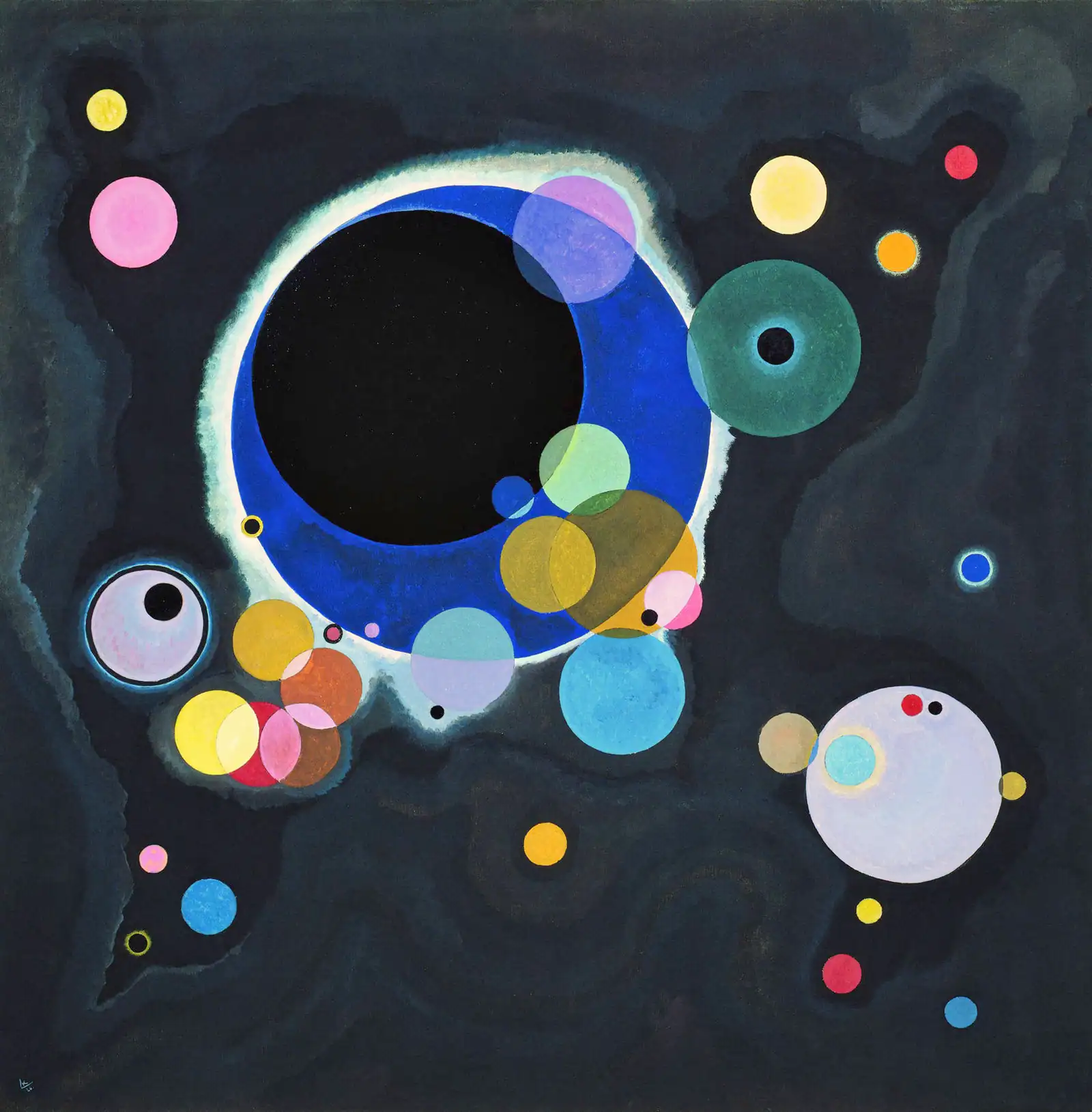
Wassily Kandinsky, Several Circles (1926), Solomon R. Guggenheim Museum, New York.A field of overlapping translucent circles floating on a dark ground, painted while Kandinsky taught at the Bauhaus. By this date he had turned from loose expression to precise geometry, treating the circle as the most eloquent of forms.Toward a Theory of Coherent Existence · page banner
Katsushika Hokusai, Dragonfly and Bellflower (c. 1833), The Metropolitan Museum of Art.A woodblock print pairing a dragonfly with bellflowers, from Hokusai’s bird-and-flower work of the 1830s. These close-up nature studies, boldly cropped and flatly coloured, were later admired by European painters for their design.Excuse me, Carl.
Katsushika Hokusai, South Wind, Clear Sky (Red Fuji) (c. 1830–32), The Metropolitan Museum of Art.A woodblock print showing Mount Fuji glowing red-brown at dawn against a blue sky streaked with cloud. Also from the Thirty-six Views, it reduces the mountain to a few broad, near-abstract areas of colour.On Creating
Katsushika Hokusai, Sparrows and Chrysanthemums (c. 1830s), The Metropolitan Museum of Art.A colour woodblock print of sparrows among chrysanthemum blooms, from Hokusai’s large bird-and-flower designs. The Metropolitan dates it to about 1825, though the untitled “large flowers” group to which it belongs is more usually placed around 1831–33.Turning Toward ADHD
Katsushika Hokusai, Under the Wave off Kanagawa (The Great Wave) (c. 1830–32), The Metropolitan Museum of Art.A colour woodblock print showing a towering wave about to break over boats, with Mount Fuji small in the distance. From the series Thirty-six Views of Mount Fuji. Its deep blue relied on newly available imported Prussian blue pigment.On Facing
Johannes Kepler, Platonic Solids model, from Mysterium Cosmographicum (1596).An engraving nesting the five regular solids inside one another to explain the spacing of the six known planets’ orbits. It was the first major published defence of Copernican astronomy; Kepler kept faith with the model even after finding orbits were elliptical.Frequency, Resonance, and the Architecture of Reality
Athanasius Kircher, Arithmologia, engraved titlepage (1665), Wellcome Collection.The frontispiece to Kircher’s study of the hidden mysteries of numbers, printed in Rome. It shows the all-seeing eye within a Trinitarian triangle and ranks of angels, with a magic square below. Despite its subject, the book sets out to debunk much number superstition.On Asking
Athanasius Kircher, Magnes sive de Arte Magnetica, frontispiece (1643), Science History Institute.The frontispiece to Kircher’s treatise on magnetism. Kircher treated magnetism as a universal force of attraction binding the whole cosmos, using chains to link God, the heavens and the earth. Held by the Science History Institute.On Magnetizing
Athanasius Kircher, Systema Ideale, from Mundus Subterraneus (1668).A dramatic cutaway of the Earth showing a central fire feeding channels to volcanoes on the surface. Kircher had himself been lowered into the crater of Vesuvius, and imagined the planet as a living body threaded with fire and water.On Populating
Gustav Klimt, Farm Garden with Sunflowers (1907), Österreichische Galerie Belvedere, Vienna.A densely packed square canvas of flowers filling the frame almost to the edges, painted during Klimt’s summers on the Attersee in Austria. The high viewpoint and absence of horizon turn the garden into a shimmering, near-abstract tapestry of blooms.Turning Toward Mental Health
Hilma af Klint, The Ten Largest, No. 2, Childhood (1907), Hilma af Klint Foundation, Stockholm.One of a series of ten very large paintings charting the human life cycle from childhood to old age. Painted in tempera on paper mounted on canvas, the sheets are so large that af Klint likely worked on the studio floor.On Learning
Hilma af Klint, The Ten Largest, No. 4, Youth (1907), Hilma af Klint Foundation, Stockholm.From the same 1907 series, representing youth in swirling forms, flowing script-like marks and soft colour. Af Klint, working within a spiritualist circle, kept her abstract work largely private and asked that it stay hidden until decades after her death.On Joining
Hilma af Klint, The Ten Largest, No. 7, Adulthood (1907), Hilma af Klint Foundation, Stockholm.Representing adulthood in the ten-part cycle, its dense loops and lettering set against a warm ground. Af Klint made radically abstract work several years before Kandinsky, Malevich or Mondrian, though it stayed almost unseen until the late twentieth century.Home
Hilma af Klint, The Ten Largest, No. 9, Old Age (1907), Hilma af Klint Foundation, Stockholm.The old-age panel of the 1907 series, quieter in palette than the earlier stages. The full set was created in only a matter of weeks. Held by the Hilma af Klint Foundation in Stockholm, which controls the artist’s large surviving body of work.On Completing
Laurent de La Hyre, Allegory of Arithmetic (c. 1650), Walters Art Museum, Baltimore (acquired by Henry Walters with the Massarenti Collection, 1902); photograph by Ad Meskens.A poised young woman personifies Arithmetic, holding a book inscribed with Pythagoras’s name and a sheet showing basic calculations, painted in a cool, classicising style. The Walters version is generally regarded as a replica; the primary version of the composition is in the Netherlands.On Counting
Georges de La Tour, The Newborn (c. 1645–48), Musée des Beaux-Arts de Rennes.A quiet nocturne of a woman holding a swaddled infant while another shields a candle, its flame the picture’s only light source. La Tour was largely forgotten for centuries and only rediscovered by scholars in the early twentieth century.Turning Toward the Subconscious
Fitz Henry Lane, Owl's Head, Penobscot Bay, Maine (1862), Museum of Fine Arts, Boston.A still coastal scene bathed in even, glassy light. Lane, who walked with difficulty after a childhood illness, is associated with the American Luminist manner, in which calm water and precise atmosphere convey a meditative stillness.Turning Toward Anxiety
Leonardo da Vinci, Lady with an Ermine (c. 1489–91), Czartoryski Museum, Kraków.The sitter is Cecilia Gallerani, mistress of Ludovico Sforza, Duke of Milan, whom Leonardo served. The ermine she cradles carries layered meaning, punning on the Greek for the animal and alluding to the duke’s own emblem. One of only four surviving female portraits by Leonardo.On Being
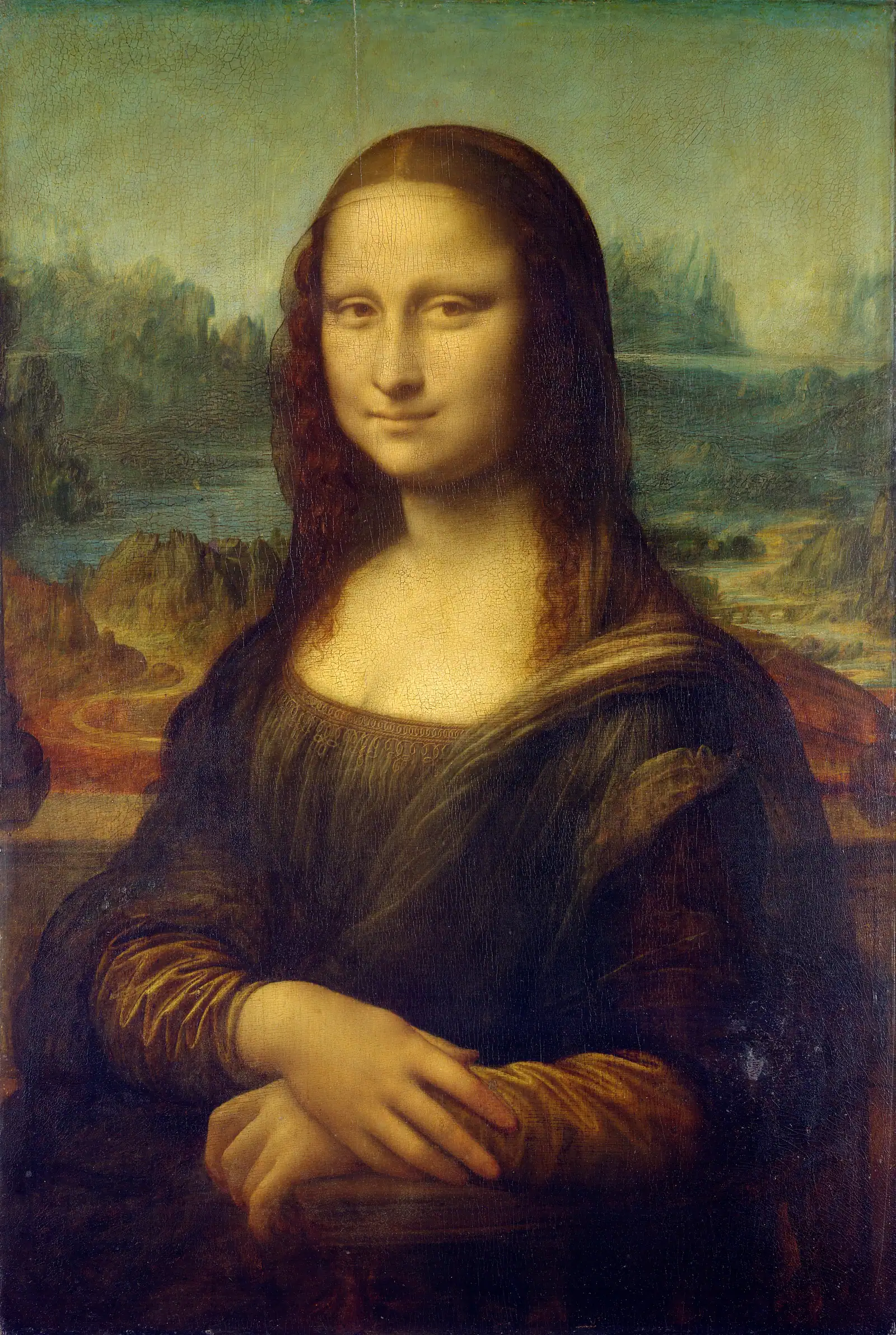
Leonardo da Vinci, Mona Lisa (c. 1503–16), Musée du Louvre, Paris.A half-length portrait, probably of Lisa Gherardini, wife of the Florentine merchant Francesco del Giocondo, painted in oil on a poplar panel and worked on over more than a decade. Leonardo never delivered it, keeping and reworking the picture until his death in France in 1519.Image Credits · page banner
Leonardo da Vinci, On the Eye and Vision (c. 1490–1510), Wellcome Collection.A leaf of notes and diagrams exploring how the eye receives light and forms images, written in Leonardo’s mirror script. It reflects his long enquiry into optics and perception. Held by the Wellcome Collection in London among its holdings on the history of medicine.On Searching
Leonardo da Vinci (after), Rhombicuboctahedron, from De Divina Proportione (1509).A woodcut of a twenty-six-faced solid rendered as a hollow glass form, so the eye reads front and back at once. Printed in Luca Pacioli’s De Divina Proportione in 1509 after Leonardo’s drawings, it is the earliest known graphic depiction of the shape.On Explaining
Leonardo da Vinci, Studies of Water, and a Seated Old Man (c. 1508–9), Royal Collection Trust.A page of pen studies analysing how water moves, eddies and falls. Leonardo watched turbulence with the eye of an engineer, comparing swirling currents to curling hair. Part of the collection amassed at Windsor and held by the Royal Collection Trust.The Buck Stops Here
Leonardo da Vinci, Vitruvian Man (c. 1490), Gallerie dell'Accademia, Venice.A pen-and-ink study of a man inscribed in a circle and a square, illustrating the proportions the Roman architect Vitruvius described. Made around 1490, it is normally kept in storage and rarely shown, because light exposure would damage the fragile drawing.On Returning (coda)
Attributed to Mi Youren, Cloudy Mountains (c. 1130), Cleveland Museum of Art.A handscroll dated 1130 of misty riverside mountains, given by the painter to a host who sheltered him after the Jurchen invasion drove the Song court south. Built from layered wet ink dots, it is one of Cleveland’s earliest dated Chinese paintings.On Dreaming
Michelangelo, The Creation of Adam (1508–12), Sistine Chapel, Vatican City.A fresco on the Sistine Chapel ceiling showing God reaching towards a languid Adam, their fingers nearly touching, painted between 1508 and 1512 for Pope Julius II. In 1990 the physician Frank Meshberger argued that the shape framing God matches a cross-section of the human brain — a much-discussed but speculative reading.Faith
Claude Monet, Impression, Sunrise (1872), Musée Marmottan Monet, Paris.A hazy view of the harbour at Le Havre at dawn, with the sun a smudge of orange over the water. The critic Louis Leroy, writing in Le Charivari in April 1874, seized on the title to mock the painters as “Impressionists” — a label the group then adopted.Turning Toward Suicidal Thoughts
NASA, ESA, P. Kalas and J. Graham (UC Berkeley), Debris Ring around Fomalhaut (2004), NASA/ESA Hubble Space Telescope.The first resolved visible-light image of the dust ring circling the bright star Fomalhaut, made with Hubble’s coronagraph. A bright point announced in 2008 as a planet was later reinterpreted as an expanding cloud of dust from a collision of icy bodies.Jays and Photons
NASA, ESA and the Hubble Heritage Team (STScI/AURA), Deep field of distant galaxies (2006), NASA/ESA Hubble Space Telescope.A long-exposure image in which almost every point of light is a distant galaxy rather than a star, made by pointing Hubble at an apparently empty patch of sky. Such deep fields let astronomers look billions of years back towards the early universe.On Expanding
NASA, ESA, CSA, A. Pagan (STScI), A. Gáspár (Univ. Arizona), Fomalhaut's Dusty Debris Disc (2023), NASA/ESA/CSA James Webb Space Telescope.An infrared image made with Webb’s mid-infrared instrument, revealing not one but three nested belts of dust around Fomalhaut — the two inner belts never seen before. Their gaps and structure suggest the gravitational pull of unseen planets shaping the debris.On Arriving
NASA, ESA, and J. Lotz and the HFF Team (STScI), Galaxy Cluster Abell 370 (2017), NASA/ESA Hubble Space Telescope.The final image of Hubble’s Frontier Fields programme, showing a massive galaxy cluster whose gravity bends and magnifies the light of galaxies far behind it. The stretched streak known as “the Dragon” was, in 1988, among the first features confidently identified as gravitational lensing.On Gravitating
NASA, ESA, M. Livio and the Hubble 20th Anniversary Team (STScI), Mystic Mountain, Carina Nebula (2010), NASA/ESA Hubble Space Telescope.A three-light-year-high pillar of gas and dust in the Carina Nebula, being eroded by radiation from nearby young stars while infant stars inside it fire off jets. Hubble captured it in February 2010 to mark the telescope’s twentieth anniversary in orbit.On Becoming
Ogata Kōrin, Rough Waves (c. 1704–09), The Metropolitan Museum of Art.A two-panel folding screen showing stormy sea waves with clawlike fingers of foam against gold leaf. Kōrin outlined the water using an old Chinese method of holding two brushes together. The screen bears a seal from a name he adopted in 1704.On Shaping
Raphael, The School of Athens (1509–11), Apostolic Palace, Vatican City.A fresco in the Vatican’s papal apartments gathering the great philosophers of antiquity beneath a vast vault, with Plato and Aristotle at the centre. Several thinkers are thought to wear the features of Raphael’s contemporaries, with Plato often identified as Leonardo.The On ——ing Series · page banner
Raphael, The Transfiguration (1516–20), Pinacoteca Vaticana.Raphael’s last painting, left unfinished at his death in 1520 and completed by his workshop. It fuses two episodes: Christ transfigured in glory above, and below the disciples failing to heal a possessed boy. The panel was displayed at the head of Raphael’s funeral.On Seeing
Rembrandt van Rijn, The Return of the Prodigal Son (c. 1661–69), State Hermitage Museum, St Petersburg.A late work depicting the kneeling son received by his father’s gentle hands, painted in the last years of Rembrandt’s life in warm, muted tones. The father’s two hands appear subtly different, one firmer and one softer, a detail much discussed by later viewers.On Forgiving
Andrei Rublev, The Trinity (1411 or 1425–27), Trinity Lavra of St Sergius, Sergiyev Posad.An icon showing three angels at Abraham’s table, understood as an image of the Holy Trinity; sources give either 1411 or 1425–27. Long held at Moscow’s Tretyakov Gallery, it was transferred to the Church and reinstalled at the Trinity Lavra of St Sergius in 2024, over the objections of the gallery’s restoration council.Alignment, the Triad, and the Architecture of Shared Mind
Carl Spitzweg, The Bookworm (c. 1850), Museum Georg Schäfer, Schweinfurt.An elderly scholar perched on a library ladder, clutching books under each arm and between his knees. Spitzweg gently mocks bookish absorption while clearly sharing it. A much-loved example of German Biedermeier painting, held at Schweinfurt.On Finding
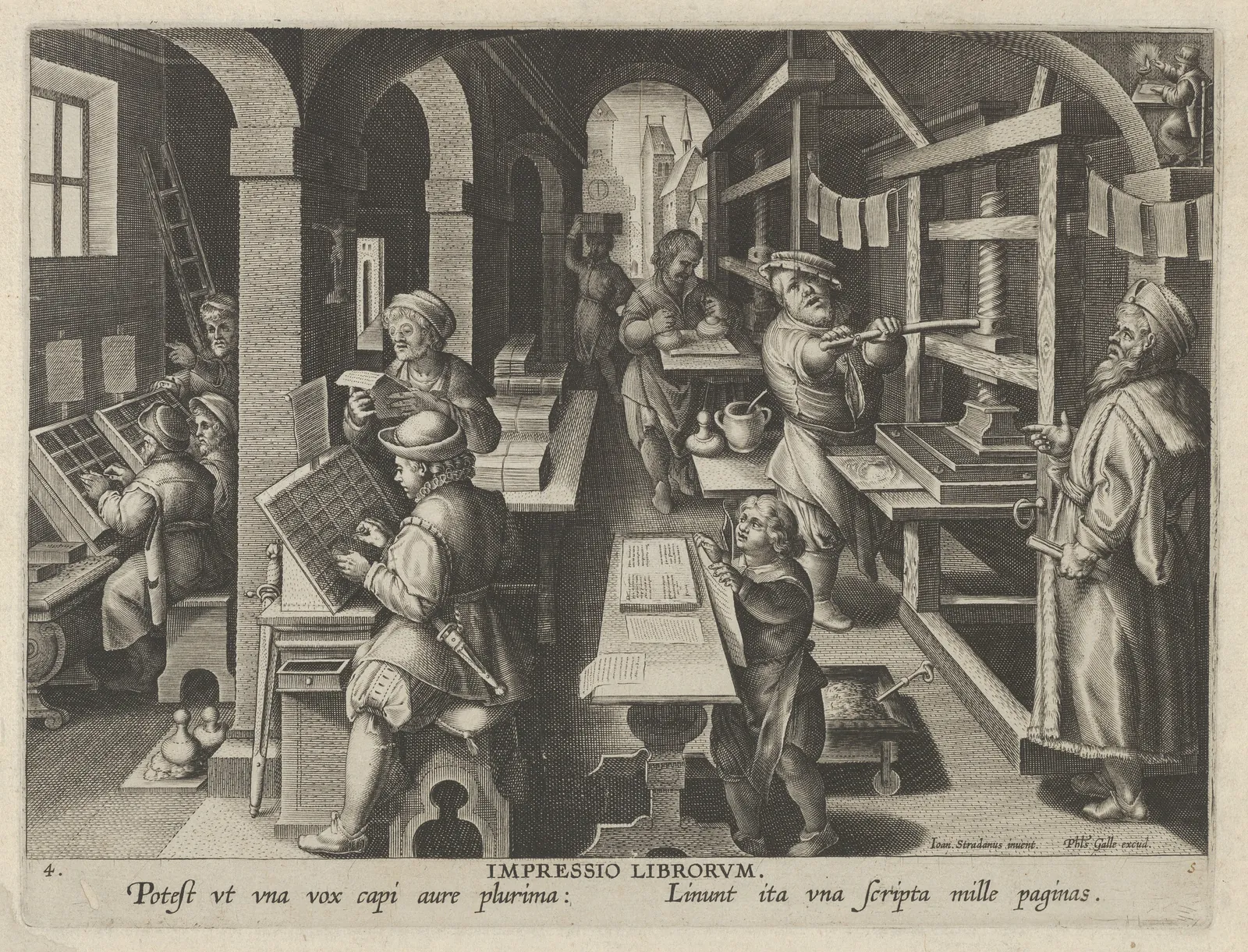
Jan Collaert I after Jan van der Straet (Stradanus), The Invention of Book Printing, from Nova Reperta (c. 1600), The Metropolitan Museum of Art.Plate four of the Nova Reperta, Stradanus’s survey of the inventions that set the modern age apart from antiquity, published in Antwerp by Philips Galle. Compositors set type at their cases, a boy checks freshly printed sheets, and pressmen work the press while pages hang to dry overhead. The Latin caption says that as one voice is heard by many ears, one writing fills a thousand pages.About this site · page banner
Thailand, Seated Buddha (15th century), The Metropolitan Museum of Art.A Thai bronze figure of the seated Buddha from the Sukhothai and Ayutthaya cultural sphere. The smooth, elongated features and flame-like finial reflect Thai conventions for representing the Buddha’s enlightened state.On Observing
Tibet, Mandala of Jnanadakini (late 14th century), The Metropolitan Museum of Art.A Tibetan mandala in distemper on cloth, centred on the goddess Jñānaḍākinī amid her emanations. The refined style points to a Newari artist from the Kathmandu Valley working for a Tibetan monastery, part of a large set of related mandalas.On Teaching
J.M.W. Turner, Norham Castle, Sunrise (c. 1845), Tate, London.A late Turner in which the Northumberland castle dissolves into blue and gold light. Left in his studio and unseen in his lifetime, its near-abstract handling of light led later viewers to see Turner as anticipating Impressionism.Artwork · page banner
Utagawa Hiroshige, Bird and Wild Carnation (c. 1830s), Art Institute of Chicago.A vertical bird-and-flower print pairing a bird with wild carnation (nadeshiko), from Hiroshige’s nature designs of the 1830s. Such small studies drew on Chinese and Japanese painting traditions and were prized for their economy of line and colour.On Testing
Utagawa Hiroshige, Naruto Whirlpool, Awa Province (c. 1853), The Metropolitan Museum of Art.A print showing the tidal whirlpools of the Naruto Strait in swirling blues and white spray, from the series Famous Places in the Sixty-odd Provinces. The subject echoes Hokusai’s wave imagery a generation earlier.Turning Toward Addiction
Utagawa Hiroshige, Shinagawa: Sunrise (c. 1833–34), Art Institute of Chicago.A print from the Fifty-three Stations of the Tōkaidō showing a procession entering the post town of Shinagawa at dawn. The series, following the great road between Edo and Kyoto, was the best-selling landscape set in the history of Japanese prints.On Living
Utagawa Kuniyoshi, Cats Forming the Characters for Catfish (c. 1842).Cats twist and pile together to form the written characters for catfish (namazu). Kuniyoshi produced several such playful pictures during a period when official censorship of actor and courtesan prints pushed artists towards animal subjects.Comparisons
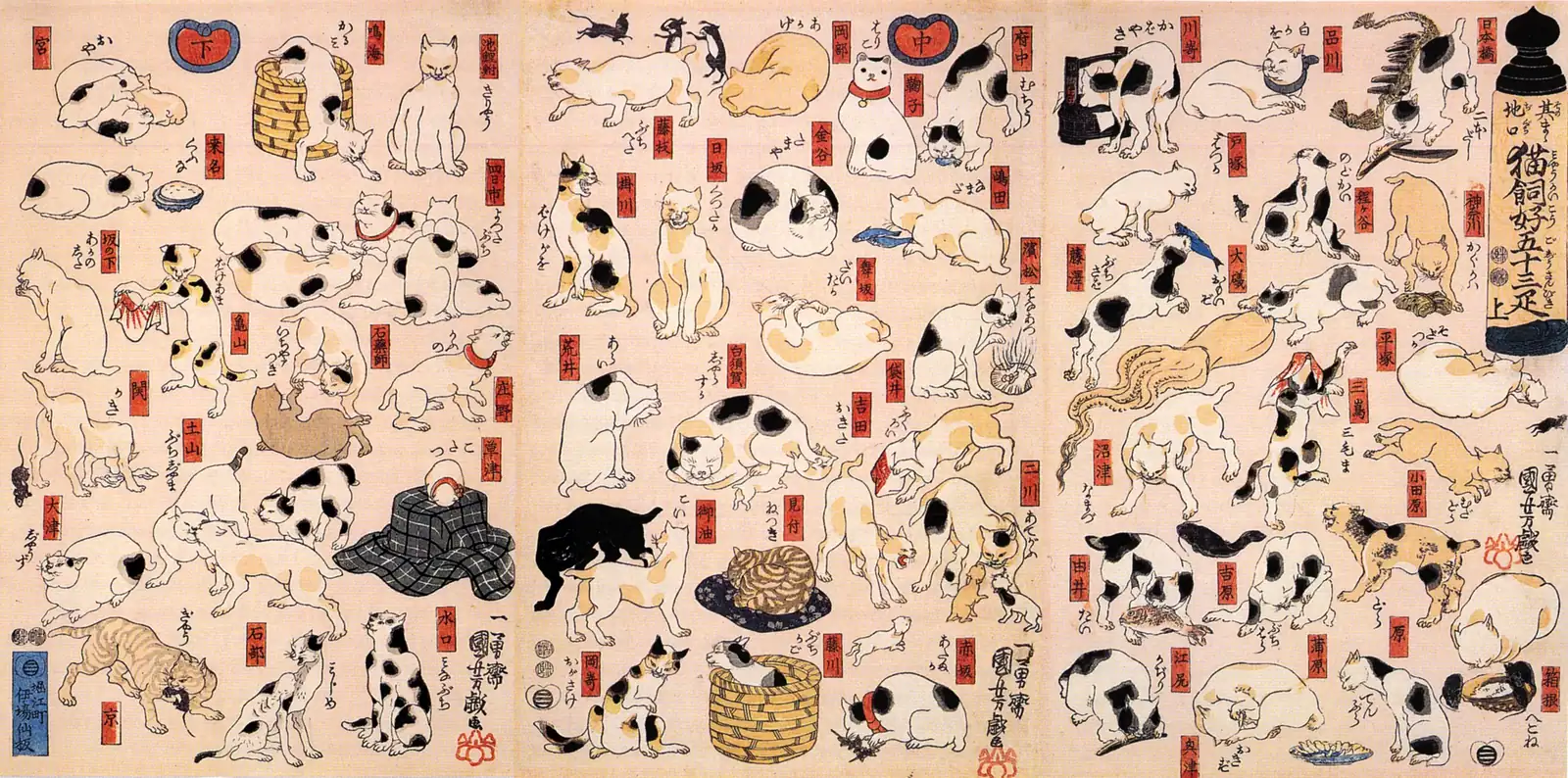
Utagawa Kuniyoshi, Cats Suggested as the Fifty-three Stations of the Tōkaidō (1850).A triptych in which fifty-five cats stand in for the stations of the Tōkaidō road, each a visual pun on a place name. A comic riff on Hiroshige’s famous landscape series by an artist known for his fondness for cats.Conscious Cat
Diego Valadés, Great Chain of Being, from Rhetorica Christiana (1579).A copperplate engraving showing the ordered hierarchy of creation from God down to the lowest matter. The book, printed at Perugia, is often described as the first published in Europe by a Mexican-born author, the Franciscan friar Diego Valadés.Toward a Theory of Coherent Existence
Johannes Vermeer, Woman Holding a Balance (c. 1664), National Gallery of Art, Washington.A woman stands in soft window light weighing empty scales, a painting of the Last Judgement hanging behind her. Long thought to be weighing gold or pearls, close study shows the pans are empty, making the scene a meditation on balance and moral judgement.On Witnessing
Andreas Vesalius, Male figure showing veins and arteries, from De humani corporis fabrica (1543), Wellcome Collection.A woodcut from the Fabrica of 1543, Vesalius’s landmark anatomy printed at Basel, showing the body’s blood vessels laid bare in a standing figure. The plates are traditionally linked to the workshop of Titian, though the artist is not documented.Nitrate–NO Pathway Overview
Joseph Wright of Derby, A Philosopher Lecturing on the Orrery (c. 1766), Derby Museum and Art Gallery.A lecturer demonstrates a mechanical model of the solar system to a rapt audience lit by a hidden lamp. Wright made the drama of scientific enquiry his subject, replacing the divine light of religious painting with the glow of a scientific instrument.On Computing
Joseph Wright of Derby, The Alchymist in Search of the Philosopher's Stone (1771), Derby Museum and Art Gallery.An alchemist kneels before a glowing flask, in a scene usually linked to the historical discovery of phosphorus by Hennig Brand. Wright combined the theatrical candlelit style of his lecture scenes with a moment poised between old alchemy and new chemistry.Outside the Darkness
Thomas Young, Sketch of two-source wave interference (1803).A diagram showing how two sets of waves overlap to form a pattern of reinforcement and cancellation, used by Young to argue that light is a wave. It relates to his Bakerian Lecture of 1803; the familiar drawing appears in his published lectures a few years later.On Questioning
The Turning Toward tiles
The seven Turning Toward tiles are simple sketches made for those essays. They are not part of the borrowed collection above.
71 works, drawn from the open-access programmes of The Metropolitan Museum of Art, the
J. Paul Getty Museum, the Van Gogh Museum, the British Museum, the Royal Collection, the Wellcome
Collection, and Wikimedia Commons. All are public domain or CC0. No work still in copyright appears
anywhere on this site.