The Work · Main journals
Toward a Theory of Coherent Existence
Four journals and their companions, tracing how an aligned life leaves legible traces — ripples of intent through time.
The journals7 pieces


 Journal 32026-05-31Frequency, Resonance, and the Architecture of Reality

 The Jay and the Quark2026-06-07A Perspectival Dual-Aspect Monism

 Faith2026-07-10The Fractalization of the Same Image
Hover a title for its subtitle. Each DOI opens the record on Zenodo (CC BY 4.0).
A theory of coherent knowledge is not threatened by new information — it is completed by it. Every challenge that holds is a thread woven in; every one that breaks shows where the weave was thin. Coherence earns its name only by surviving contact with what it did not expect.
Toward a Theory of Coherent Existence asks whether the many ways we have of knowing the world — science, philosophy, art, and the contemplative and religious traditions — might be describing one underlying field rather than many separate ones.
Not a single doctrine that swallows the rest, but a shared structure beneath them: the way aligned lives and aligned ideas leave legible traces through time, and the way those traces, when they reinforce one another, build into something coherent and durable. The work treats this as a philosophical framework, not a finished empirical claim — a lens, carefully held. Keeping that distinction honest is part of the method, not an apology for it.
At its center is a simple image: that intention, attention, and meaning behave a little like waves. Where they align, they reinforce — constructive interference — and a pattern becomes legible. Where they don't, they cancel, and the signal is lost to the noise. The four journals develop this from different angles: the cosmology of traces, the dual-aspect view in which mind and matter are two faces of one process, the mathematics that tries to make the idea precise, and the open questions — chief among them the combination problem — that the framework does not pretend to have solved. A companion paper, The Jay and the Quark, sets out the perspectival dual-aspect monism at the framework's core; and a further essay, Faith, carries it into the world's religions, reading them as fractalizations of a single image.
The four journals are the assembled core of a thirty-year distillation of independent research and journaling — first drawn together on 31 May 2026, then refined as the framework matured. Each record's upload date is shown beside its DOI.
It is offered not as an answer, but as a coherent place to stand while asking better questions.
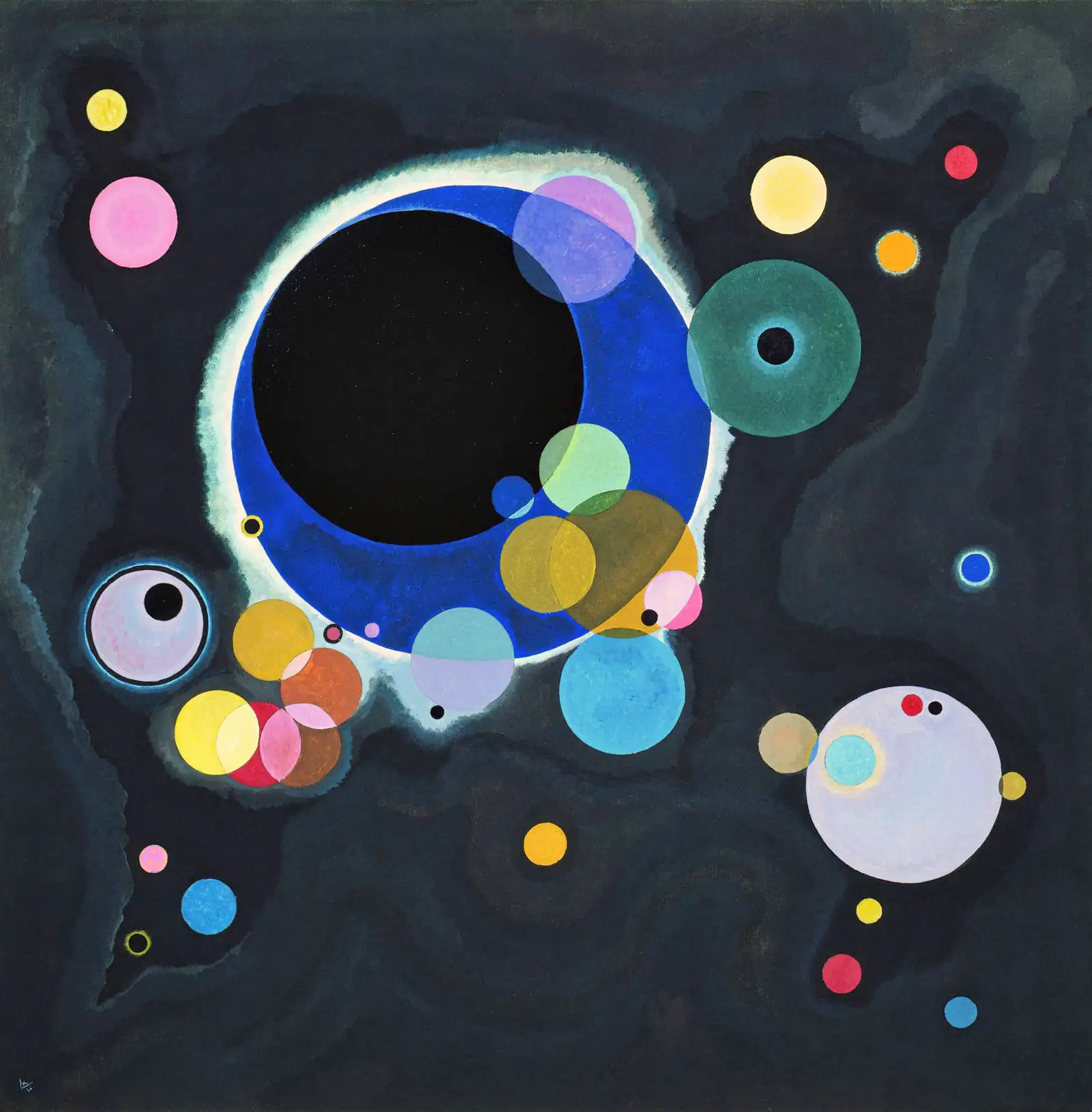
Banner artwork Wassily Kandinsky, Several Circles (1926), Solomon R. Guggenheim Museum, New York. Public domain or CC0 — full list in the image credits.